Showing posts with label 1960s. Show all posts

Tuesday, October 30, 2012

The Hippie Fashion in the 1970s


The hippie fashion style we wear today has a rich history behind it. The hippie movement, incited mostly by young people, was started in the late 1960s and early 1970s. The hippie fashion is defined by a carefree, non-conformist attitude toward life, love, and politics. Hippies inherited a tradition from bohemians and the beat generation in the late 1950s. 

Around the late 1960s, many young people were concerned with social values; their passion and resulting actions developed into an anti war movement. Some hippies opposed Australian involvement in the Vietnam War, while others were concerned about nature. In the early 1970s, young people strongly called for peace, love, and freedom.


These often nomadic hippies were frequent drug users. Their style was inspired by non-Western cultures, such as Indian and African. Hippie clothing is usually made out of natural fibers and free flowing materials. Flowing and romantic fabrics are very popular among hippies.


Let's dress like a Hippie!!!


 1.     No bras or corsets! Be comfortable!
      2.     Wear male clothing such as baggy trousers, jackets, vests, over—sized shirts, ties and hats.
      3.     Wear “midi” (knee length) or “maxi” (floor length) skirts!
      4.     Have some flower prints.
      5.     Wear Pocahontas headband!
      6.     Wear a chain or thick belt.
      7.     Have a peace symbol!
      8.     Wear boots or have bare feet!

Tuesday, October 23, 2012

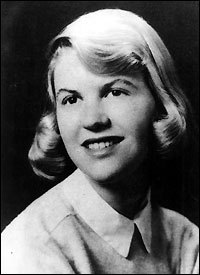
The Sylvia Plath Effect

     While we were discussing about the Confessional Poetry Movement in the 1960s, during which poems were written in the first person, "I," and were highly personal, we talked about some amazing poets, such as Anne Sexton and Sylvia Plath. What caught my attention was the issue of the Sylvia Plath Effect.


     In 1932, Sylvia Plath was born in Massachusetts. When she turned eight, her father died from diabetes, and his death left a huge impact on her and her poetry, most notably in the poem "Daddy." Plath was an ambitious woman, as she made her first national publication in the Christian Science Monitor in 1950. She was also an outstanding graduate from Smith College as a summa cum laude in 1955.


     Plath was often associated with the Confessional Poetry Movement. Her poems often presented violent images and "playful use of alliteration and rhyme." She was also the first poet to receive a Pulitzer Prize after her death.


     The Sylvia Plath Effect is a relatively new theory in the psychological field. In 2001, James Kaufman, a psychologist who got his Ph.D from Yale University, conducted a study to show that creative writers, especially female poets, are more prone to suffer from mental disorders than any other occupations. He came up with the term "The Sylvia Plath effect" after he found out that many poets who experienced tragedy and depression eventually committed suicide in his second analysis of 520 American women. Other studies suggested that creative people are more slightly at risk, and that they are 30 percent more likely to have a "bipolar disorder."


     Arnold M. Ludwig, M.D, a psychiatrist and a professor at Brown University proposed that "creative people in the artistic profession are more likely to have a mental illness than those in less artistic professions, such as science and business," in his book "The Price of Greatness."


     Kaufman and another psychiatrist, John Baer, also theorized that female poets, who are more vulnerable to "extrinsic motivational contraints," are more likely to suffer from mental illness. They thought that creative people will often "defy the crowd" to follow their own standard, thus resulting in pressures from writing and leading up to a higher level of psychogenic illness.


     Some other writers that were considered having the same symptoms were Virginia Woolf (Modernist Movement), Sara Teasdale (lyrical poetry), Anne Sexton (Confessional Poetry Movement) and Sarah Kane (In-yer-face Theater).

Monday, October 15, 2012

Blowin' In The Wind - Bob Dylan


     Recently, our poetry class discussed about Bob Dylan, a talented artist as well as a great poet. I came across one of his song, Blowin' In The Wind. I prefer Joan Baez's cover to Bob Dylan's and Peter Paul & Mary's. I like her voice!
     Bob Dylan claimed that he wrote this song in 10 minutes on an afternoon in 1963 while listening to the melody of an old slave song, "No More Auction Block." The Bob Dylan's version of this song wasn't a hit until the band Peter Paul & Mary covered it, thus making it #2 in the U.S and introducing people to the folk music of Bob Dylan.
     Here's my own interpretation of the lyrics.

   This first stanza generally talks about Dylan's anti-war sentiment. He asked how much do people have to fight each other, before racial discrimination was banned? And how much African Americans have to suffer before they could attain peace. When would social unrest end?


     Dylan posed the questions of freedom and human ignorance. He sympathized with people who lived for generations yet could not attain freedom, and also criticized people who knew about racial prejudice problems in America but chose to ignore it.


     The "sky" represents freedom, and the "cry" represents the disregard of people. Ignorance and freedom are recurring themes in his poem. He asks "he," or the President, how many more deaths must occur to make the President notice that the racial problem in America needs a solution.


     The "wind" that Dylan mentions at the end of every stanza proposes the idea that the wind is a natural force, thus making it natural for every human being to have their rights and freedom. The poem is a resonance of the Declaration of Independence. If "all men are created equal," and have the rights of "Life, Liberty and the pursuit of Happiness," why haven't these African Americans gotten their freedom and equality in society?