Showing posts with label history. Show all posts

Saturday, November 3, 2012

The place where your dreams come true


The Walt Disney World was opened in 1971 in Lake Buena Vista, in Florida with just one park and two resort hotels. 


It was dedicated by Roy E. Disney and he declared "M
ay Walt Disney World bring Joy and Inspiration and New Knowledge to all who come to this happy place...a Magic Kingdom where the young at heart of all ages can laugh and play and learn -- together".


Ever since the opening day, Disney World expanded gradually. Today, it consists of four major Disney theme parks, two water parks, six golf courses and the Downtown Disney places. 


Today, I want to introduce 10 FUN FACTS about the Disney World!

1.Cinderella's Castle is made out of fiberglass, and it is 189 feet tall.

2. Mickey has more than 290 outfits, from a scuba suit to a lighted tuxedo. Minnie has more than 200 outfits, from cheerleading attire to evening gowns.

3. Inside the upper levels of Cinderella's Castle is an apartment that Walt Disney intended to use when he and his family were in Florida. It was left unfinished when he died, until Disney announced in 2006 that it would be turned into a deluxe suite, which is awarded randomly to a family every day. It comes complete with 24-karat gold tile floors and a "magic mirror" that turns into a television.

4.  It takes 68 years to stay in a different room every night at the Disney World resorts

5. Disney World decorates more than 1,500 Christmas trees at holiday time.

6.  When Disney World opened, adult admission to the Magic Kingdom cost $3.50. Today it costs $85.


7. Disney World flew its flags at half-staff on the day Apple co-founder Steve Jobs died. Jobs was Disney's largest single shareholder (7 percent), and he was on the board of directors.

8. The first film made at Disney's Hollywood Studios was "Ernest Saves Christmas."

9.  Disney World has closed only three times because of of hurricanes: Sept. 15, 1999, for Floyd; Sept. 4-5, 2004, for Frances; and Sept. 26 of that same year for Jeanne.

10. Disney's infrastructure has more than 270 buses


Wednesday, October 31, 2012

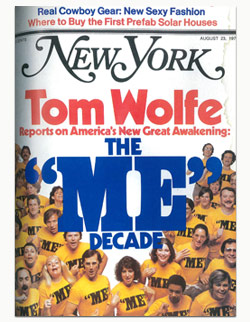
The "Me" Decade

     In August 1976, the novelist Tom Wolfe published the essay, "The "Me" Decade and the Third Great Awakening" in the New York Magazine. He gave the 1970 decade the name "The Me Decade" because of the way Americans retreated from social and political activities, and turned to individual wellbeing. The Webster's New World College Dictionary defines "The Me Decade" as "the decade of 1970s thought of as characterized by narcissicism, self-indulgence, and a lack of social concern in many, esp. younger people." What factors contributed to the change in people's attitude during this time? 


     There were economic problems rising on the surface. Americans had been enjoying their time of economic boom after the end of World War II, up to the 1960s. The economic growth gradually decreased in the 1970s. In 1979, the Arabians limited the oil export, forcing the gas price in America to dramatically increase. At the same time, the automobile industry in America had to compete with Japan carmakers. In addition, the inflation rate was rising, which meant that good's prices were higher than wages, thus putting people in difficult positions. Therefore, Americans had to involve themselves in improving the economy, which meant that they did not have the time to think about political and social problems. 


This book was popular during the Me Decade.

     The changing social structure also helped explain the reason behind the differences in people's reactions. The baby boomers from after World War II were getting out of college, and many of them were busy settling down with their families. The war in Vietnam also ended, and thus people didn't have to march protests anymore. Americans gave up trying to refine the world, and focused on improving themselves. The only exception to this ideal was the feminist movement.  


     American culture was also popularized during this period as TV became widespread. Many TV programs and shows were created for people's entertainment. People could watch soap opera, comedies, sports, etc on TV without going outside. Thus, they became more inward and sluggish. Their lives revolved around television. 


     Looking good, eating well, and feeling fine were the major interests of the people. The media was filled with discussion about reactivities and sensations. Discos, night clubs, and bars were the escape routes from social, economical, and political problems. However, "The Me Decade" in 1970s gave way to new attractions and affluence in the 1980s.  

Tuesday, October 30, 2012

The Hippie Fashion in the 1970s


The hippie fashion style we wear today has a rich history behind it. The hippie movement, incited mostly by young people, was started in the late 1960s and early 1970s. The hippie fashion is defined by a carefree, non-conformist attitude toward life, love, and politics. Hippies inherited a tradition from bohemians and the beat generation in the late 1950s. 

Around the late 1960s, many young people were concerned with social values; their passion and resulting actions developed into an anti war movement. Some hippies opposed Australian involvement in the Vietnam War, while others were concerned about nature. In the early 1970s, young people strongly called for peace, love, and freedom.


These often nomadic hippies were frequent drug users. Their style was inspired by non-Western cultures, such as Indian and African. Hippie clothing is usually made out of natural fibers and free flowing materials. Flowing and romantic fabrics are very popular among hippies.


Let's dress like a Hippie!!!


 1.     No bras or corsets! Be comfortable!
      2.     Wear male clothing such as baggy trousers, jackets, vests, over—sized shirts, ties and hats.
      3.     Wear “midi” (knee length) or “maxi” (floor length) skirts!
      4.     Have some flower prints.
      5.     Wear Pocahontas headband!
      6.     Wear a chain or thick belt.
      7.     Have a peace symbol!
      8.     Wear boots or have bare feet!

Monday, October 15, 2012

The King of Rock and Roll

(1935-1977)


When I was little, all I heard in the car was Presley's music. My mother was in love with him and always made me listen to his songs. So today, I would like to talk about him. 

(My favorite..."Jailhouse Rock")

One of the most famous musicians of the 20th century, Elvis Aaron Presley was born on January 8, 1935 in Tupelo, Mississippi. He was an American singer and actor. His twin brother was stillborn so he grew up as an only child. In 1948, Elvis and his family moved to Memphis, Tennessee. 

His carrer started in 1954 when he started working with Sun records. He sent his recording to RAC victor  and his first RAC single, "Heartbreak Hotel" became very popular. His style was unique and it became famous among a variety of races.

(Heartbreak Hotel)

After being drafted into the military in 1968, he came back to live performance in LasVegas. He was popular not only in America but also in many other countries. He had sold more than a billion records and this broke a record. He was nominated for 14 Grammy nominations, the Grammy Lifetime Achievement Award, and he is being named One of the Ten Outstanding Young Men of the Nation for 1970 by the United States Jaycees. 

On August 9, 1997 he died at the age of 42 because of his heavy drug use. Throughout his great career, he popularized rock 'n' roll in America. After his death, he still remains as the one of the world's most famous music icons. 


•Rock and roll music, if you like it, if you feel it, you can't help but move to it.
That's what happens to me. I can't help it.

•I don't know anything about music. In my line you don't have to.

•Truth is like the sun. You can shit it out for a time, but it ain't goin' away.

•Man, I really like Vegas

Sunday, October 7, 2012

Roles of Women in the 1950s


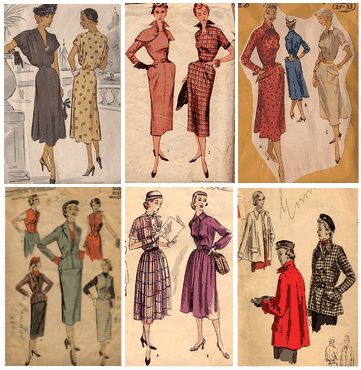
In the 1950s, men came back from the World War II, and women were encouraged to return home and do household chores instead of working out side of the houses. They were expected to be perfect mothers, obedient wives, and diligent housewives. As perfect mothers, they had to stay home to take care of children. As obedient wives, they had to agree with their husbands and comfort them. As diligent housewives, they had to prepare dinner right on time when husbands arrived at home from their work.


Here was a women's daily routine during the 1950s
1. Wake children up, cook breakfast for them, and send them to school
2. Clean the dishes with minimum noise and do laundry
3. Prepare dinner for their husbands and make sure that their husbands were the main focus of the evening


There was the expectation that women would always stay home because it was the men who went out to work and had real jobs. Women eventually were able to have real jobs but earning total respect took a long time. Now women have the freedom to choose whatever they want to do.


In the 1950s, patterns, especially checks and flower pattern dresses were in vogue. They wore long dresses to emphasize femininity. It was because of women's duty at home and men were the ones who went out to work and wore pants.


Sunday, September 30, 2012

Irish Discrimination

From the mid 1800s to the early 1900s, when famine was raging in Ireland, Irish immigration to America came. Many Irish who were starving and sick tried to escape from death by sailing to Canada. Those of the Irish who survived found America for a new place to live. In America, because Irish were unskilled at everything and could not speak English properly, they were discriminated against. There were many labor advertisements that said, "HELP WANTED, NO IRISH NEED APPLY". If they were employed, they were forced to work long hours for minimal payment. 

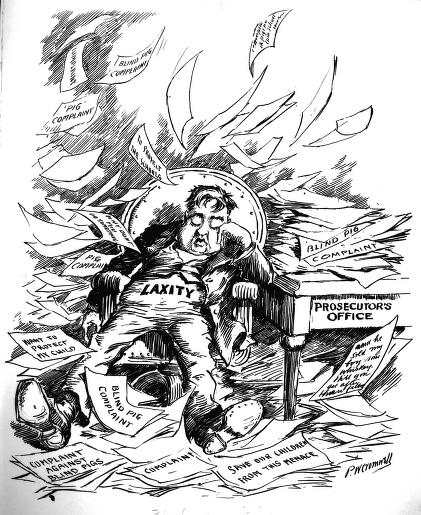
This picture is illustrating the way Irish supposedly did things
After 1855, the Irish started to build a lot of ships such as steamships and that made discrimination less permanent. In the 19th century, a Board of Commissioners of Immigration opened the city's first immigrant reception station which was called Castle Garden. It was a place where immigrants were received. After it closed, the attitude towards Irish started to change. After the Civil War occurred, they finally began to gain respect.  

Sunday, September 16, 2012

Chicago during 1920s


                            Organized Crime in Chicago

During the 1920's and 30's, Chicago was the perfect city for organized crime. Chicago was industrialized and many immigrants came to Chicago to look for opportunities for better living. Around this time, organized criminal activity, which included hustling, was popular because it was easy to make money without having actual jobs. However, there were two major reasons why organized criminal activities increased during the 1920's and 1930's in Chicago.


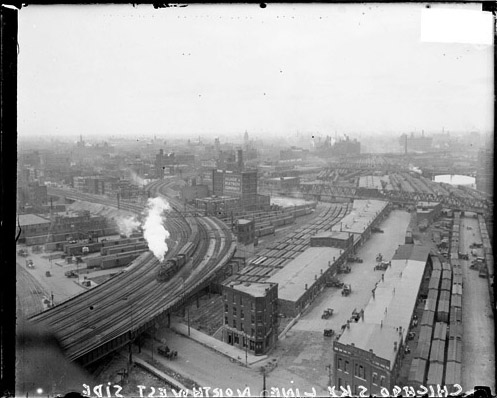
                       Industrialized Chicago in the 1920's and 30's

The first reason was the rapid increase in population. As I mentioned earlier, the large influx of immigrants increased the rate of organized crimes. Also, crooked behavior of politicians and police in Chicago allowed organized crime to grow as it did. 


The second reason was that children in Chicago were exposed to criminal activities at young ages. As they matured, their early experiences grew and become professional criminal activities. 

The third reason was prohibition. The law banning alcohol was passed in 1919. It took joy away from people. A sunday without a smile, no games, no music, and no dancing made things worse. Prohibition increased the rate of organized crime and created a huge drop-off in consumption because there were many businesses with alcohol in Chicago. So they ended up selling them illegally. When the government forces people to do something, it is more likely to fail than succeed.